


Megan’s Journey Beyond Perfectionism
Over Time
Megan spent years striving for perfection and external validation through traditional portraiture, only to realize it detached her from the pure joy of making.
Chasing Perfection
The Geometry of Unbecoming
Every artist eventually arrives at a reckoning with their early instincts.
For Megan, that moment began not in a sudden crisis, but in the slow, relentless movement of time.
As she approaches her Saturn’s return, she finds herself reflecting on the silent agreements she made with her craft as a child.
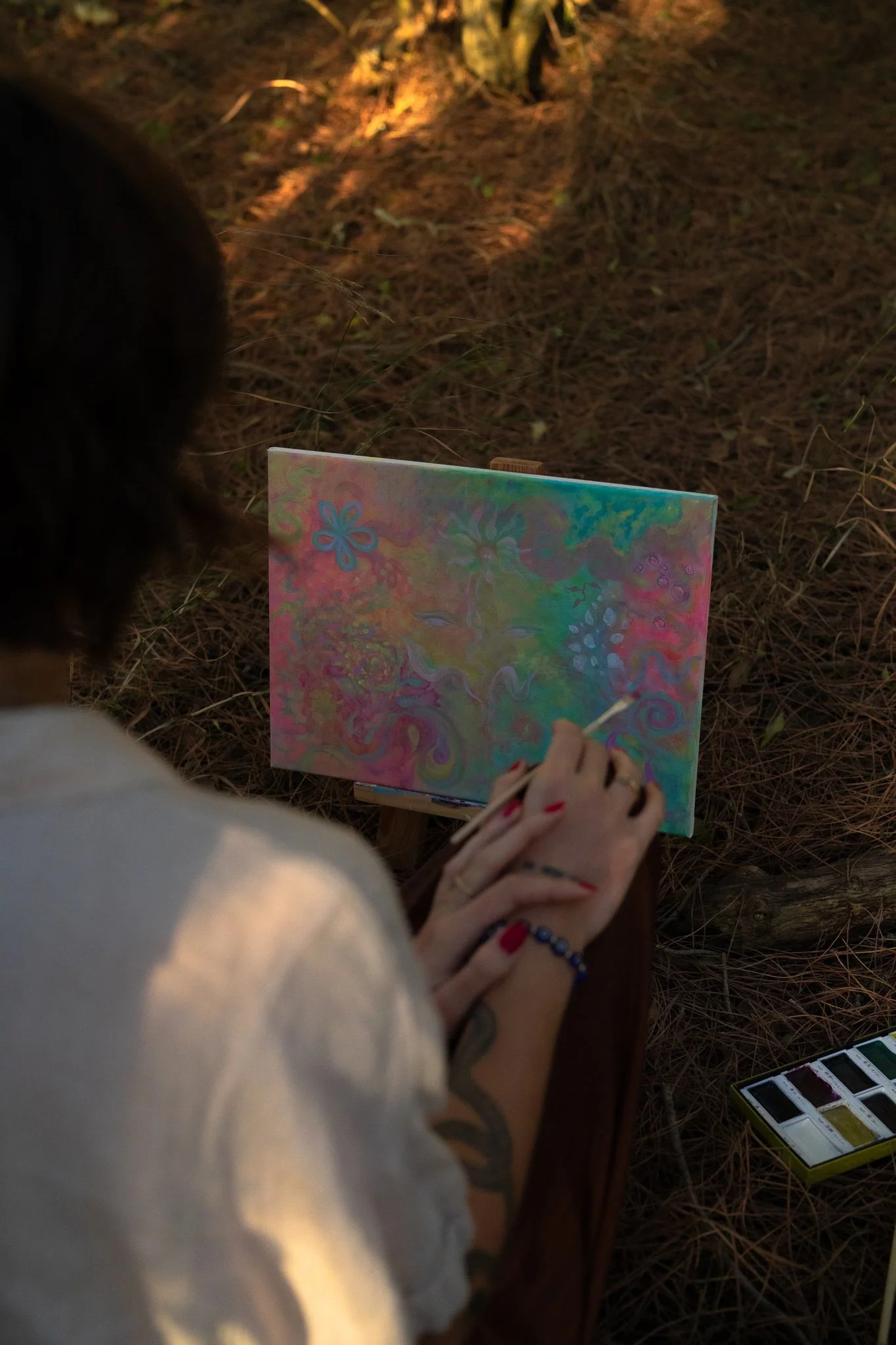
Guided by the quiet isolation of the lockdown years, she dismantled her need for performance. Today, she paints in acrylics without a blueprint, embracing mistakes as part of the narrative. Her work is an invitation to strip away expectations and reconnect with wonder.
To understand Megan is to understand a young artist raised in the American South, bathed in a culture that equated goodness with compliance, precision, and visible proof of skill.

The World Paused
The external demands vanished. Stripped of the need to perform or produce recognizable art for public approval, Megan was forced to confront the fundamental question at the heart of her practice:
Why create if nobody is watching?
Then came the stillness of 2020.
She started assistant teaching art at fifteen. She mastered classical landscapes and recognizable portraits.
The world looked at her work and offered the exact validation she had been taught to seek: She has talent. She’s good.
The Work
Yet, that early mastery carried an unspoken cost. The traditionalist subject matter was a shield, a way to secure acceptance through universally recognized competence rather than raw personal truth. Perfectionism had quietly become a spotlight for fear.

Her studio practice shifted from a place of judgment to an altar for solace. The canvas ceased to be an exam; it became a playground. She began painting at night, stepping into that quiet pocket of hours after the world’s demands had fallen away, existing solely in the rhythm of her work.
What followed was a rebirth.
She began intentionally making messy, unscripted, improvised art. She abandoned forethought. She allowed acrylic paint—malleable, translucent, and bold—to become an extension of her own internal landscape rather than a tool for mimicry.
The Philosophy
"I can make a mistake," she observed during our conversation, "and then very quickly get curious about the supposed mistake...work with it instead of thinking too much about how maybe I messed up".
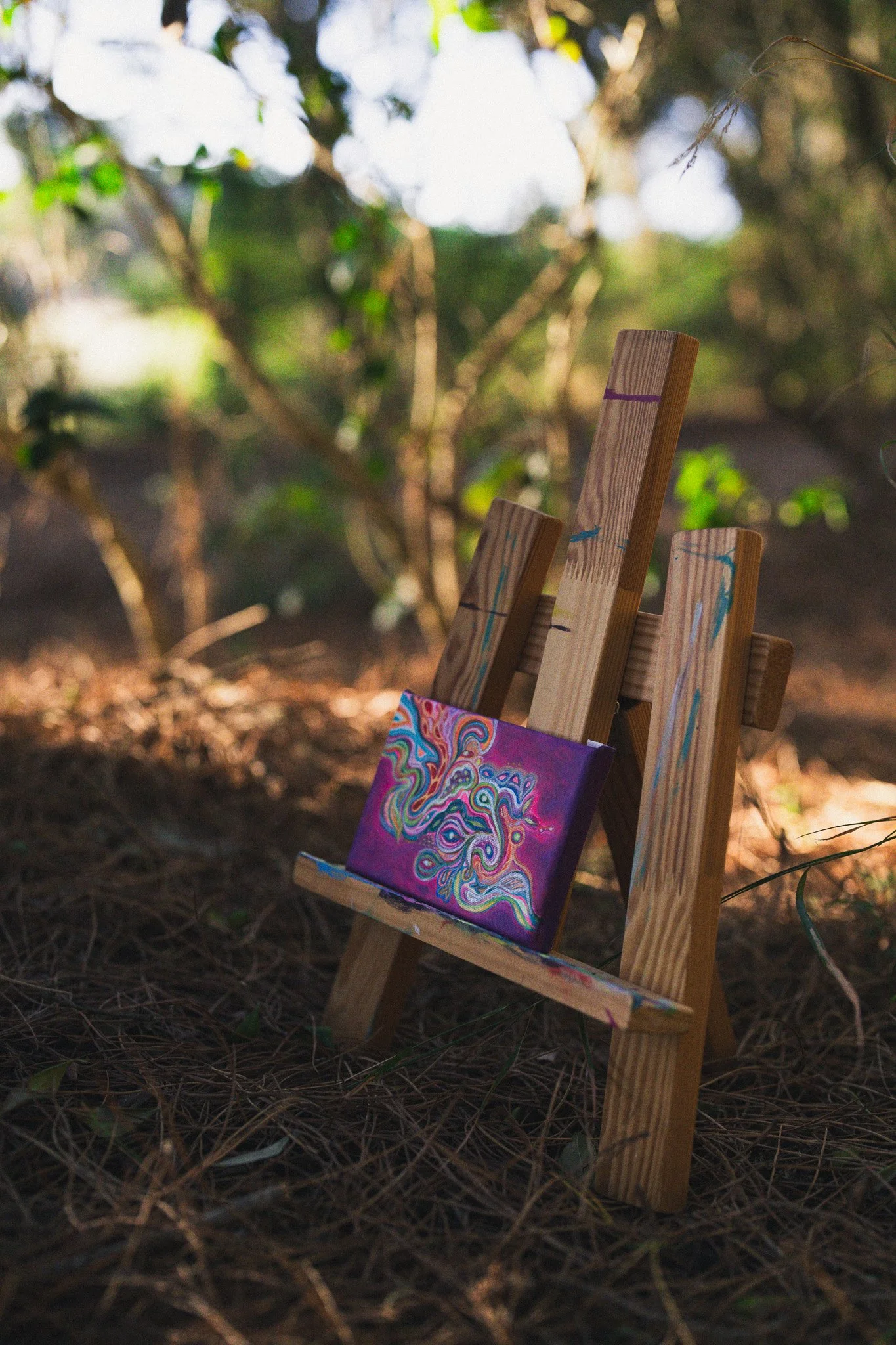

What is Really Being Built
If you look at her work alongside the child who first picked up a brush, you see the full arc of an artist who chose honesty over performance. She stopped trying to prove herself and simply allowed herself to exist.
When Megan stands in front of a blank canvas today, she is not searching for a destination. She is building dimensions, layer upon layer of color, contrast, and light, waiting for the moment the work begins to breathe back.
Her current art does not demand that you admire her technical compliance. Instead, it asks a far more provocative question: How can you go deeper, wider, and become more open to what wants to live with you?

The full image gallery can be seen at www.EddieSpeaksLovePhotography.com.